ABILITY records human neural signals over an optical link
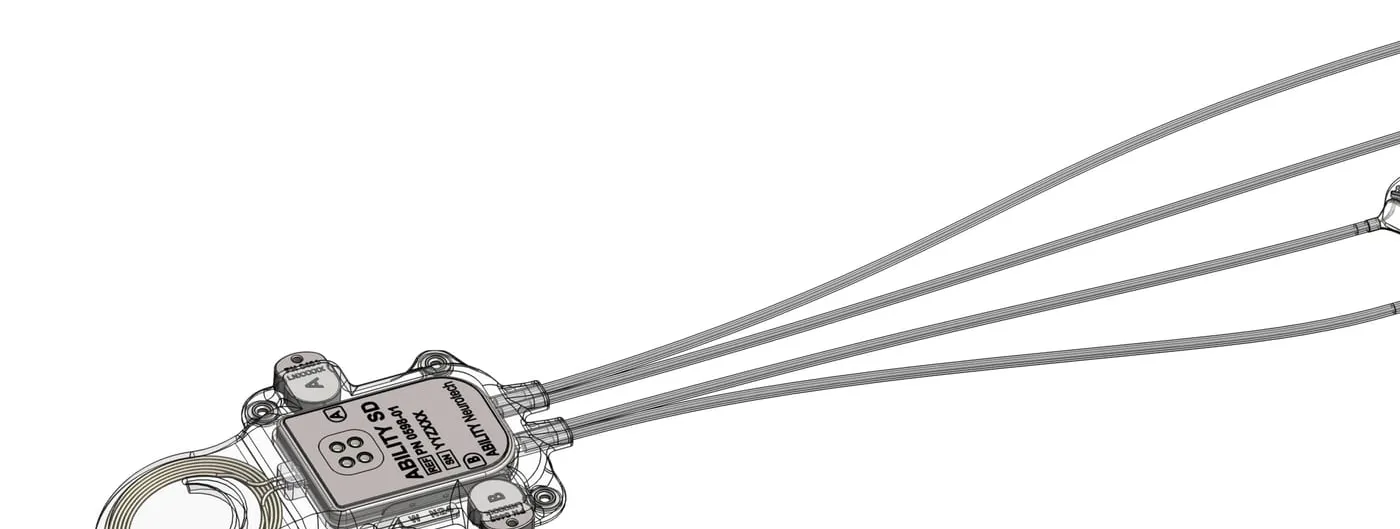
ABILITY NeurotechPress kit
ABILITY Neurotech announced on 21 July 2026 the first use of its neural signal acquisition technology in a living human, in an intraoperative procedure at the Department of Neurosurgery of TU Munich’s University Hospital Rechts der Isar. The first patient underwent full system performance testing and signal acquisition under general anaesthesia.
The study is led by Drs Wagner, Meyer and Jacob at the hospital’s Laboratory for Translational Neurotechnology. It will involve up to five people undergoing brain tumour surgery, capturing 20 to 30 minutes of intraoperative recording each. Later stages target neural decoding under the same surgical conditions, with conscious patients performing speech and motor tasks.
What distinguishes the device is how data leaves the skull. The implant reads from electrocorticography arrays sitting on the cortical surface, then transmits over an infrared laser-based optical link rather than by radio frequency, at rates the company puts at up to 50 megabits per second, with no implanted battery.
ABILITY spun out of the Wyss Center for Bio and Neuroengineering in 2025 after roughly a decade of development, and is building toward a speech neuroprosthesis for people with ALS, spinal cord injury and stroke. IEEE Spectrum reported on 20 August that a year-long chronic trial in people with ALS is planned in the Netherlands for late 2026.