A phoropter test predicted who could adapt to blended vision
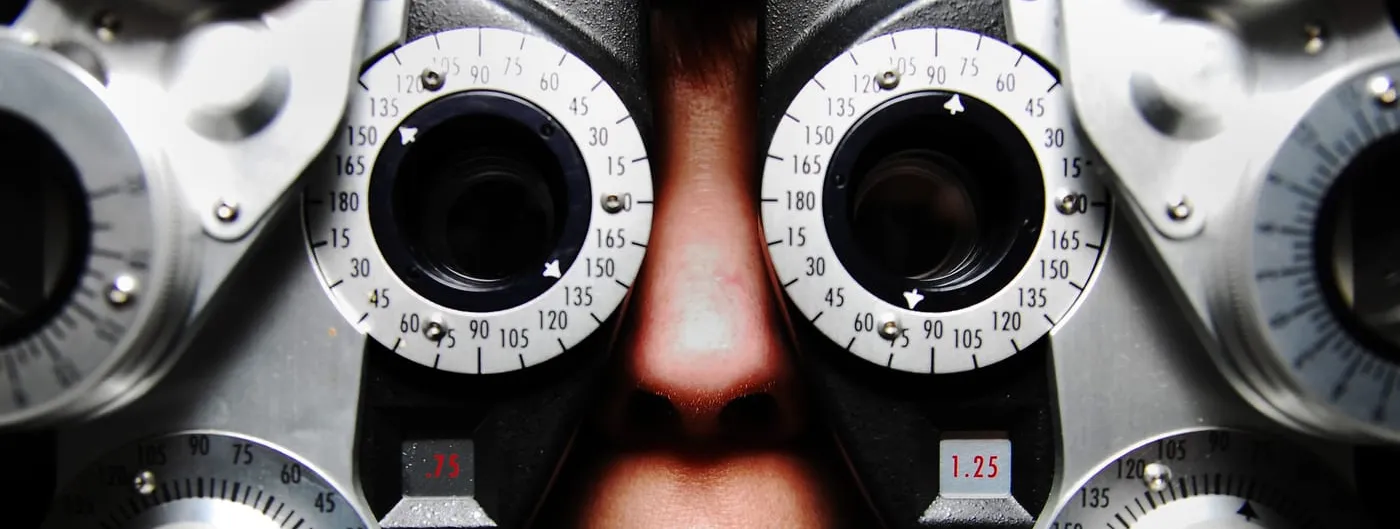
U.S. Navy photo by Mass Communication Specialist 2nd Class Jason T. Poplin, via Wikimedia Commons (public domain)Public domain

Laser blended vision treats presbyopia by correcting one eye for distance and the other for near, then relying on the brain to combine the two images. Most people can do this. Not everyone can.
At the 44th Congress of the European Society of Cataract and Refractive Surgeons, held in London from 11 to 15 September 2026, Brendan Cummings of the Wellington Eye Clinic in Dublin reported a screening method that runs before the laser. Using a phoropter — the lens-turret instrument of a routine sight test — the clinician defocuses one eye and asks the patient to rate the resulting distance vision as a percentage of normal. Patients rating at least 80% were judged able to tolerate the blend. The same assessment, combined with eye dominance, set which eye would be corrected for distance and which for near.
Across 1,341 patients, the test flagged 30 — 1.66% — as unsuitable. Among those treated, 96.9% adapted successfully. Cummings described the assessment as low-tech and said it had a high predictive value for a patient’s tolerance of blended vision.
The work was presented as a congress paper on 13 September 2026 and has not yet appeared in a peer-reviewed journal; the figures here come from the society’s own release. What it moves is the gate. A property of the patient’s own visual processing, rather than the outcome of the operation, now decides who is offered the correction.