Double neural bypass restores movement and touch in a tetraplegic man
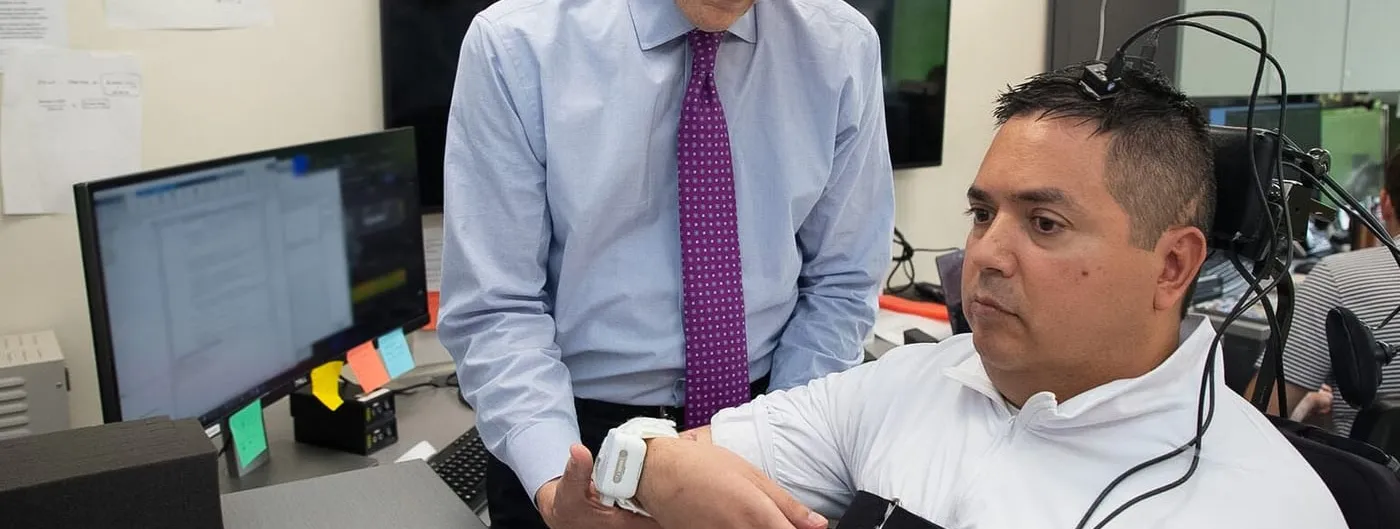
Northwell Health / Feinstein Institutes for Medical ResearchPress kit
The Feinstein Institutes for Medical Research, part of Northwell Health, published the results of its double neural bypass trial on the cover of Nature Medicine on 16 July 2026. The single participant, Keith Thomas, 48, has complete C4 sensory and C5 motor tetraplegia.
The system links five microelectrode arrays implanted in his brain, 128 channels in motor cortex and 96 in sensory cortex, to AI decoders. Decoded intent drives electrical stimulation of his forearm muscles, while signals from his hand are returned as stimulation of the sensory cortex. Non-invasive patches add spinal cord and muscle stimulation between sessions.
Over 35 weeks of intervention, within a trial that followed him for three years, Thomas gained 86% in right-arm strength and 62% in left-arm strength. He grasped and lifted hollow eggshells without breaking them 87% of the time, and the decoder held up to 84.6% accuracy over five months without retraining. The study was led by Chad Bouton of the Feinstein Institutes’ Institute of Bioelectronic Medicine.
The result comes from a single participant. What sets the design apart is that it closes the loop in both directions: the same system that carries intent from brain to muscle returns touch from hand to brain.