The male fruit fly nervous system is mapped neuron by neuron
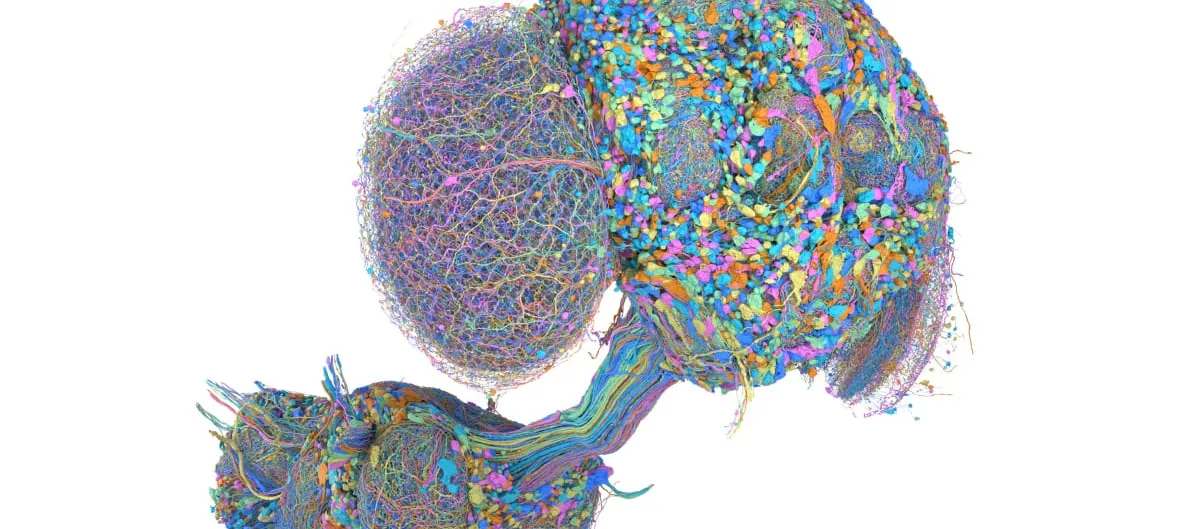
The wiring diagram of an adult male fruit fly’s central nervous system was published in Cell on 3 September 2026, mapping more than 166,000 neurons and about 125 million synapses across the brain, both optic lobes and the ventral nerve cord (DOI 10.1016/j.cell.2026.08.015). The work comes from HHMI’s Janelia Research Campus, the MRC Laboratory of Molecular Biology, the University of Cambridge and Google Research, and Google Research calls it the largest brain map by neuron count so far.
The dataset is not new to specialists: it was posted as a bioRxiv preprint in October 2025. What landed this week is the peer-reviewed publication.
The reason it matters is comparison. A female fruit fly brain and nerve cord were already mapped, so for the first time both sexes of one animal can be placed side by side at synapse resolution. The paper reports that circuits for sensation and movement are largely shared, while the neurons that differ cluster in higher brain regions — roughly 100 male-specific interneuron types that coordinate courtship and aggression. It also traces a complete taste system, from receptor to feeding, locomotion and hormone release.
A fly is not a person. But a whole nervous system read at this resolution is the reference against which every partial map of a larger brain gets checked.