A brain implant in Daejeon was driven over the internet from Chicago
Jeong lab, KAIST / KAIST newsroomPress kit
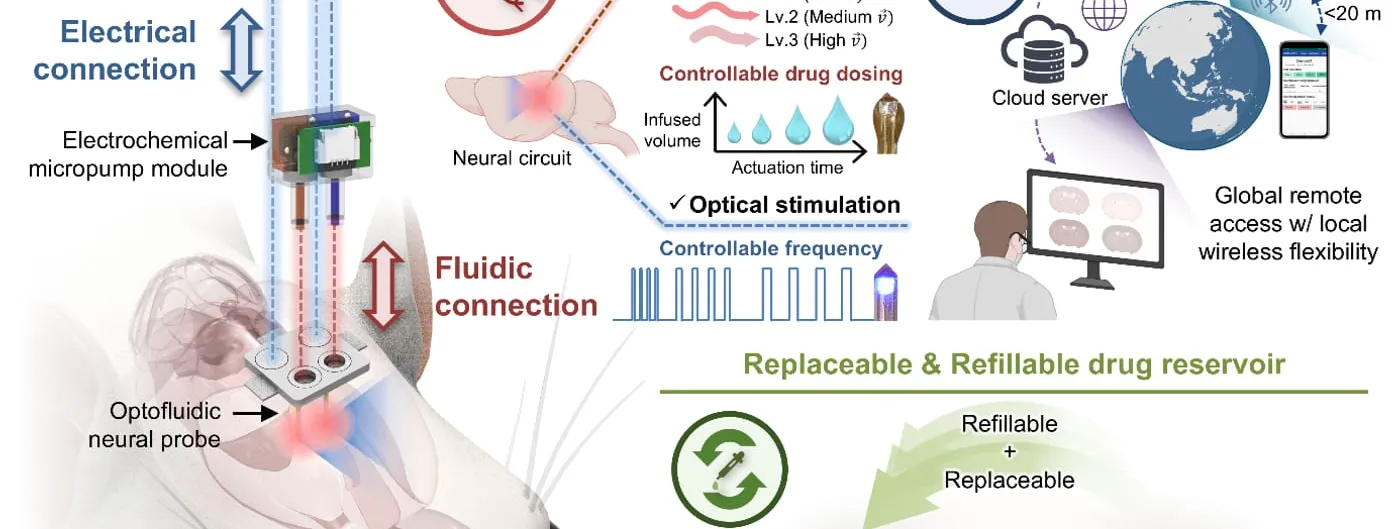
A team led by Jae-Woong Jeong at KAIST’s School of Electrical Engineering, with Wha Young Kim’s group at Yonsei University College of Medicine, built a wireless brain implant that can be programmed over the internet from anywhere and demonstrated it across more than 10,000 km. A researcher in Chicago operated the device in a rat in Daejeon, infusing cocaine into a target region while stimulating specific neurons with light from a micro-LED. The setup ran for four weeks.
The implant is roughly the size of a sugar cube and stacks three modules: a wireless circuit, an electrochemical micropump, and an optofluidic probe that carries both fluid and light into tissue. Drug flow rate and dose are settable in steps, as is stimulation frequency, and the two channels can run separately or together. The drug reservoir is held magnetically and swaps out without further surgery, which is what makes long experiments possible at all.
The work appeared in Science Advances on 29 July 2026, funded by the National Research Foundation of Korea and two Korean ministries. It is animal research, and the immediate claim is about the instrument rather than about therapy: distance stops being a constraint on who can run a neural experiment, and on how long one can last.