A 3D-printed membrane raises artificial-lung oxygen transfer by 88%
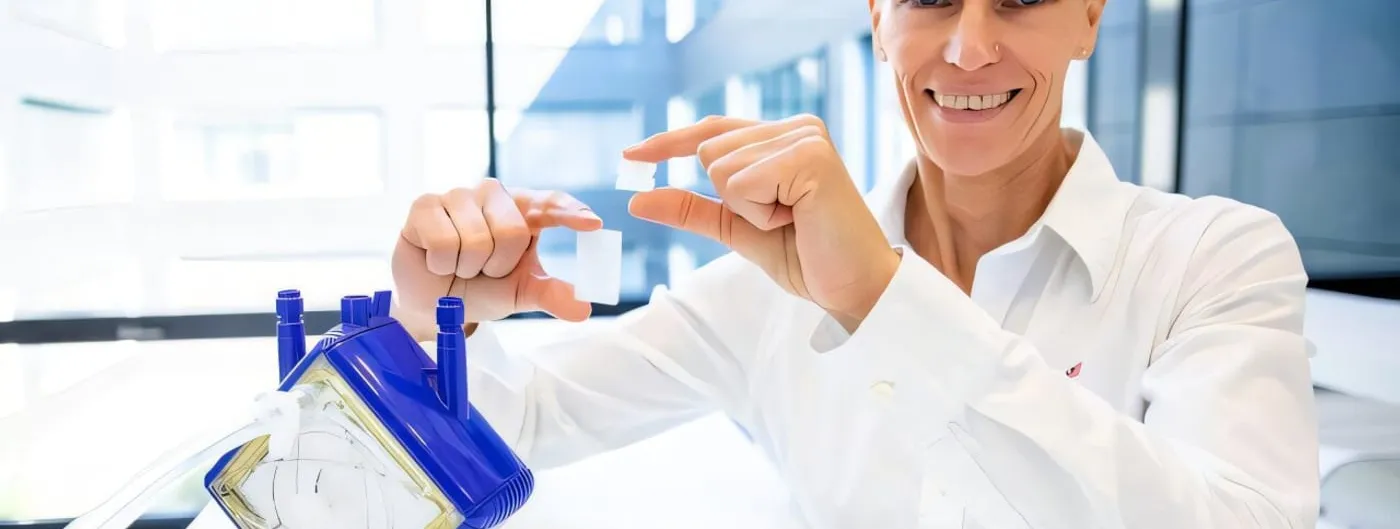
A team at Hannover Medical School and RWTH Aachen University, with the Lower Saxony Centre for Biomedical Engineering, Implant Research and Development, has 3D-printed a silicone gas-exchange membrane whose geometry is a triply periodic minimal surface rather than a bundle of hollow fibres. The work was published in Advanced Materials on 18 August 2026, under DOI 10.1002/adma.74361, and the group is led by Bettina Wiegmann.
The reported gain is up to 88% more oxygen transfer than conventional hollow-fibre membranes, with blood distributed more evenly through the structure and less resistance to flow. A minimal surface packs a large exchange area into a small volume, which is the same trick a lung performs with 100 to 140 square metres of alveolar surface folded into a chest.
This is a materials result, not a device. Nothing has been implanted, and the release describes clinical use as years away; the stated path runs through CT-guided customisation and seeding the membrane with endothelial cells so that blood meets a living surface instead of a synthetic one. That last step addresses the failure mode of today’s ECMO circuits, where clots form on the artificial surface.
Every ECMO patient is tethered to a machine at the bedside. The reason to care about packing more exchange into less volume is that it is the precondition for taking the machine off the trolley and putting it inside the body.