An MIT robot learns physical therapy technique from force feedback
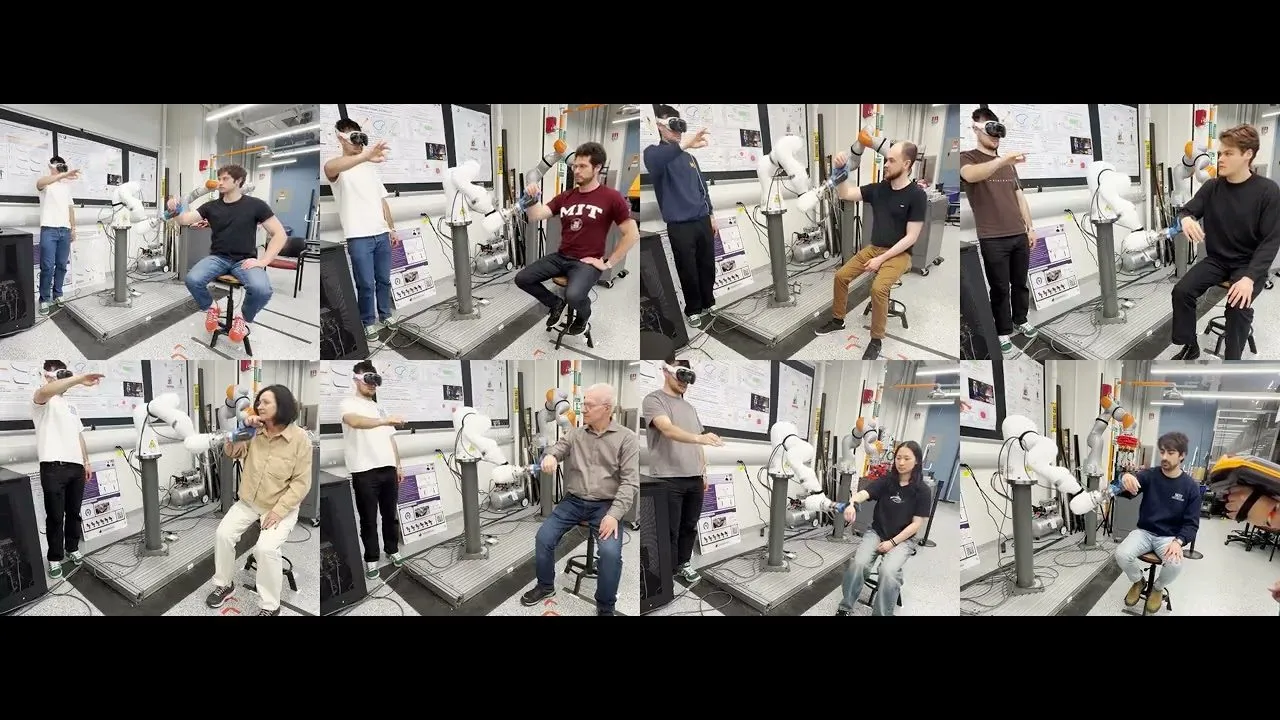
▶ Johannes Lachner — YouTubeVideo frame
Mechanical engineers at MIT built a dual-arm robot that learns the physical technique of a rehabilitation therapist rather than a fixed trajectory. The work appears in IEEE Transactions on Robotics as “Diffusion-Based Impedance Learning for Contact-Rich Manipulation Tasks”, and MIT News described it on 5 August 2026.
The system pairs transformer-based diffusion models with real-time force feedback, so the model learns how to respond to touch, force and resistance instead of planning motion alone. That distinction matters for rehabilitation, where the useful skill is knowing how hard to push and when to yield.
The prototype has been tested with healthy participants performing movements such as lifting and reaching. It has not yet been used with stroke patients. A follow-on study is running with Cristina Piazza’s lab at the Technical University of Munich and the Pfennigparade rehabilitation centre in Munich, where therapists wear force-sensing gloves while treating patients so that therapist-specific models can be built before patient trials.
The work is by Johannes Lachner, an MIT-Novo Nordisk AI Postdoctoral Fellow now at Purdue University, Noah Geiger of Robert Bosch GmbH and formerly a visiting student at MIT, and Neville Hogan, Sun Jae Professor of Mechanical Engineering and head of MIT’s Newman Laboratory for Biomechanics and Human Rehabilitation. MIT News puts the annual global stroke burden at 15 million people, of whom 5 million are left with long-term impairments.