Two humanoids learned to turn a skipping rope for a third party
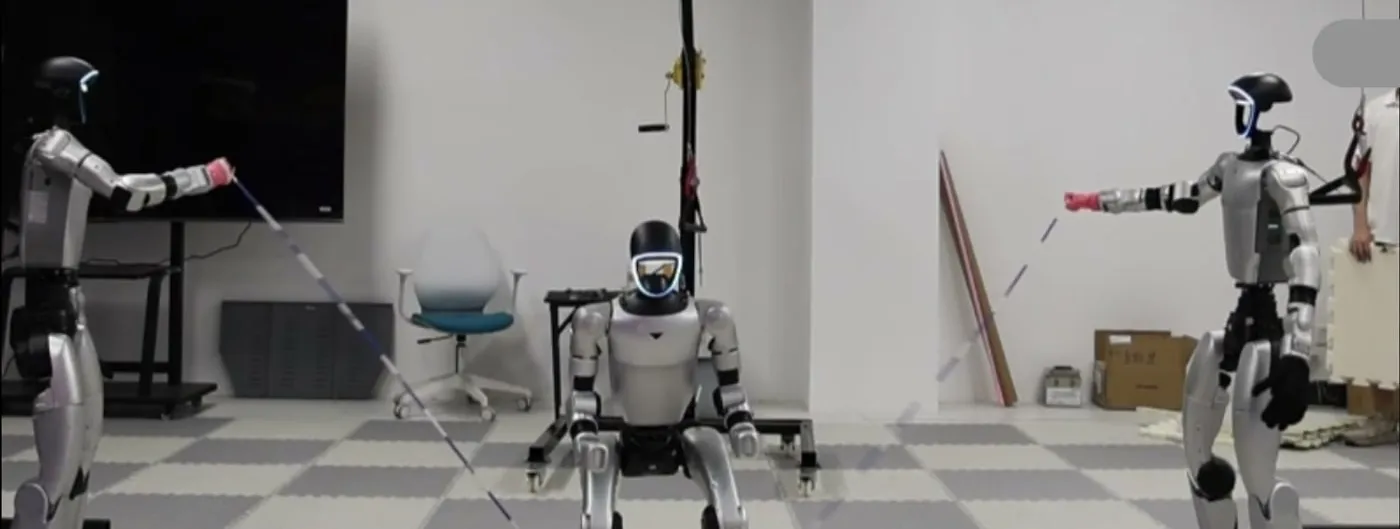
Wang et al., Nanjing University / Marope project pagePress kit
A team from the National Key Laboratory for Novel Software Technology and the School of Artificial Intelligence at Nanjing University, with the Beijing Academy of Artificial Intelligence, released a preprint on 6 June 2026 describing Marope, a system that trains two humanoid robots to turn a long skipping rope together for a jumper between them.
The problem is harder than it sounds, and the reason is instructive. Turning a long rope is not a task either robot can solve alone: the rope couples them physically, so each arm’s motion changes what the other must do, and the pair must additionally match the tempo of whoever is jumping. Marope splits this into two layers. A decentralised low-level policy, trained by multi-agent reinforcement learning, handles the rope manipulation itself. A centralised high-level policy schedules those low-level behaviours to synchronise with the jumper’s rhythm, and is trained against deliberately varied jumping styles so it generalises beyond a single partner.
The team evaluated the system in simulation and on real Unitree G1 hardware, with human, humanoid and quadruped jumpers taking turns. Reported limitations include a dependence on motion-capture tracking and support for only one jumper at a time.
The work is a preprint and has not yet been peer reviewed.