Neuralink pretrains BCI decoders on 50,000 hours of brain data
Neuralink / UpdatesPress kit
Neuralink published on 1 October 2026 a technical update describing neural encoders pretrained on the unlabeled data its clinical-trial participants have streamed since the study began: more than 50,000 hours of freeform recordings, of which over 9,000 hours, or 22.4 billion spikes, come from the first participant alone.
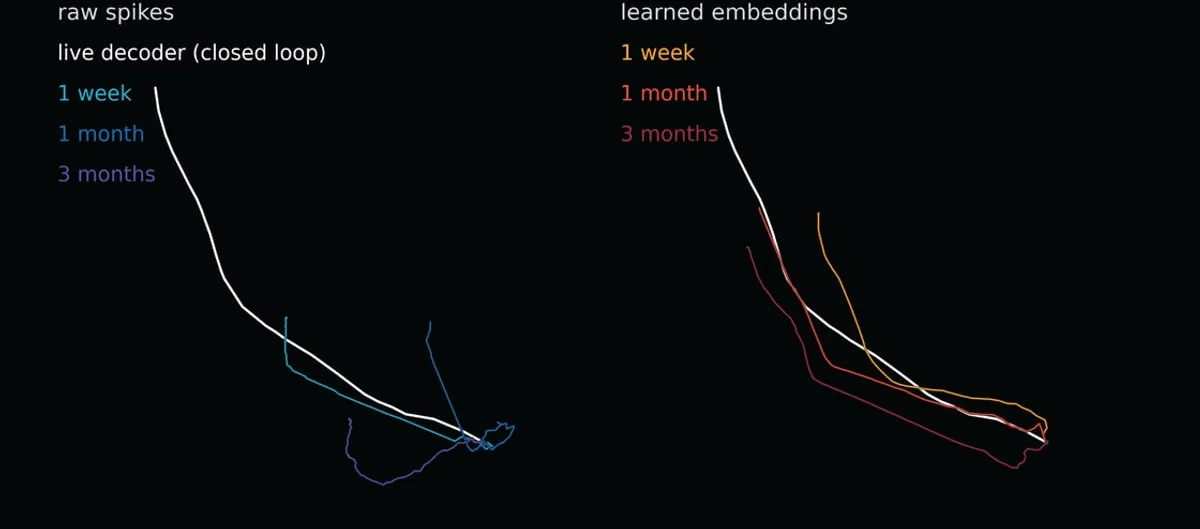
The problem the work targets is calibration. Each user’s decoder, the model that turns spiking activity into cursor movement, drifts as neural signals change, and participants spent an average of 55 minutes a week recalibrating to keep control. Neuralink trained participant-specific encoders, built on a Mamba architecture and a spatially masked objective that predicts half the recording channels from the other half, to produce embeddings that stay stable from day to day.
According to the company, six participants set personal records with the new decoders, three passed the previous best of 10.39 bits per second, and one reached 11.32 bits per second. Some decoders stayed usable for more than three weeks, and for some users calibration fell from about 10 minutes a day to 10 minutes a week.
The update is a company post, not a peer-reviewed paper. The results come from Neuralink’s own trial participants and have not been independently reproduced.