Newronika adaptive DBS pivotal trial implants its first patient
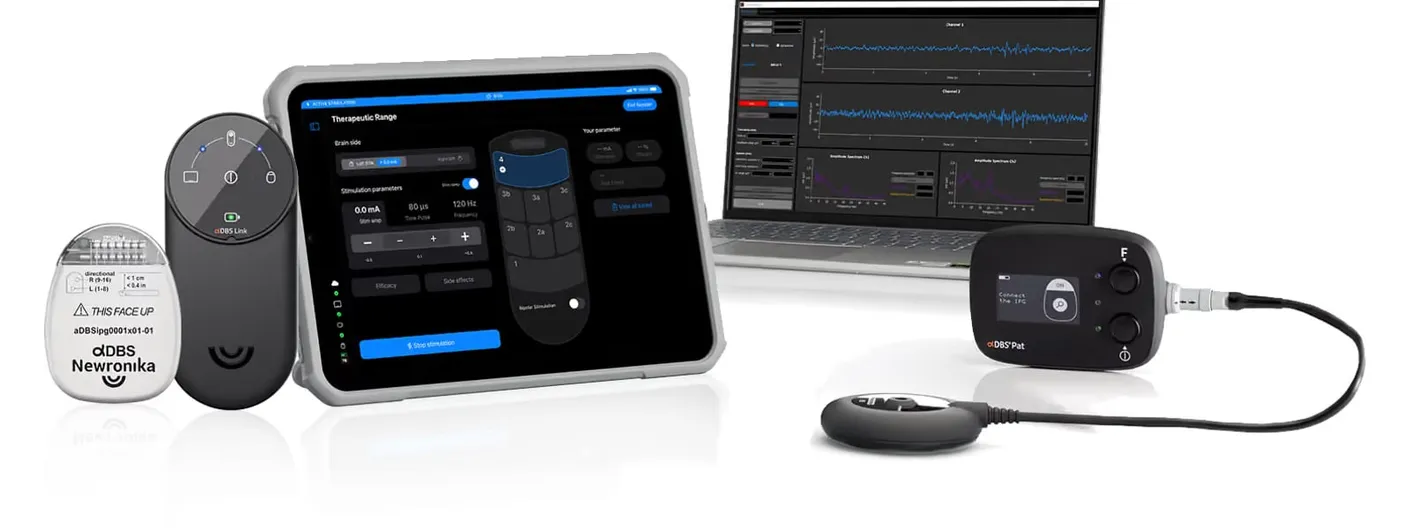
Newronika / company websitePress kit
Newronika announced on 30 September 2026 that the first participant in ADVENT, its pivotal trial of adaptive deep brain stimulation for Parkinson’s disease, received the implant on 21 September. The surgery took place at Fondazione IRCCS San Gerardo dei Tintori in Monza, Italy, where Giorgio Carrabba is the principal investigator.
Conventional deep brain stimulation delivers fixed electrical pulses, set by a clinician and adjusted at follow-up visits. Newronika’s αDBS system works in a closed loop: according to the Milan company, it continuously senses brain signals and adapts the stimulation in response. The release does not name the signal the system tracks.
ADVENT (NCT06891781) is a randomised, double-blind crossover study comparing adaptive and conventional stimulation in 104 adults with idiopathic Parkinson’s disease, at up to 18 sites in the United States and the European Union. It runs under an FDA investigational device exemption. In Europe the system already carries a CE mark for conventional or adaptive stimulation as an add-on therapy for levodopa-responsive Parkinson’s disease; in the United States it remains investigational.
Chief executive Lorenzo Rossi said the study is designed to produce rigorous evidence by comparing the two modes directly.