A cochlear electrode that releases its own anti-inflammatory
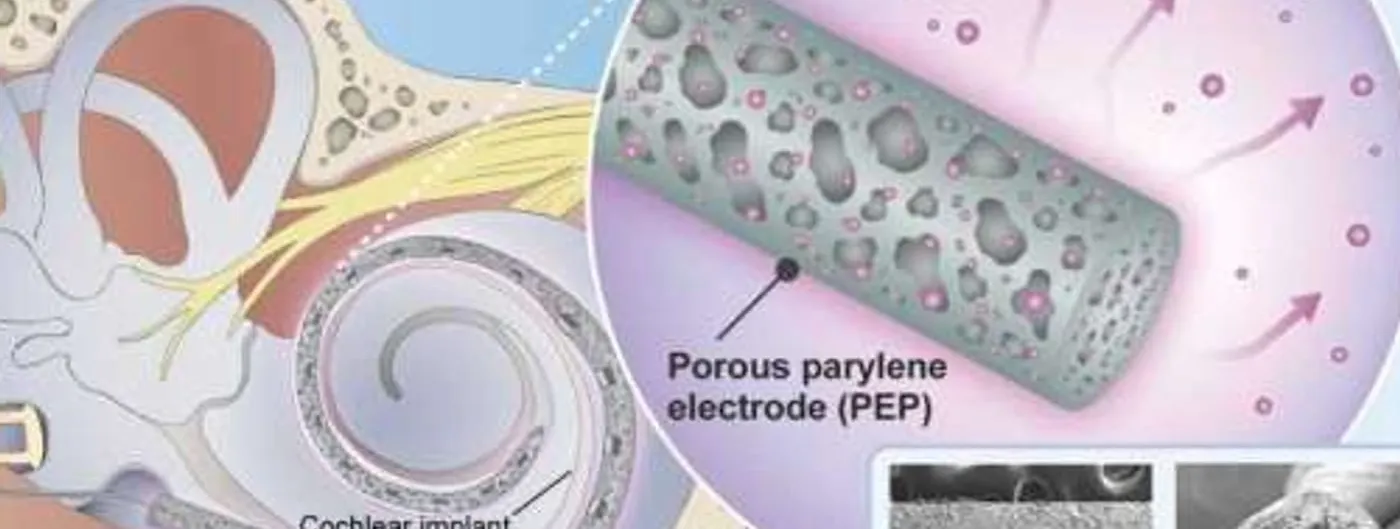
A cochlear implant restores hearing by threading an electrode array into the cochlea. The threading itself does damage: the insertion provokes an inflammatory response, scar tissue forms around the array, and whatever natural hearing the patient had left is often lost in the process.
Researchers at National Taiwan University and National Taiwan University Hospital have built an electrode that treats that injury as it happens. Reported on 11 September 2026 in Advanced Healthcare Materials, the array is made of parylene shot through with an interconnected network of pores, loaded with dexamethasone. The drug leaves the electrode into the inner ear directly, where it is needed, rather than arriving through the bloodstream.
In preclinical animal testing the loaded electrode suppressed TNF-alpha, reduced the fibrous foreign-body response, and produced better auditory brainstem response thresholds than undosed controls at both one and four weeks after surgery. The work is credited to Chi-Chieh Chang of the hospital’s otolaryngology department, with Hsien-Yeh Chen in chemical engineering and Chen-Chi Wu in otolaryngology as corresponding authors.
Residual hearing is worth protecting. Patients who keep some low-frequency hearing can combine it with the implant’s electrical signal, and that combination reliably beats the implant alone in noise and in music.