Lab-grown nerve hits human sensory conduction speed on a chip
Rice University, via Medical XpressPress kit
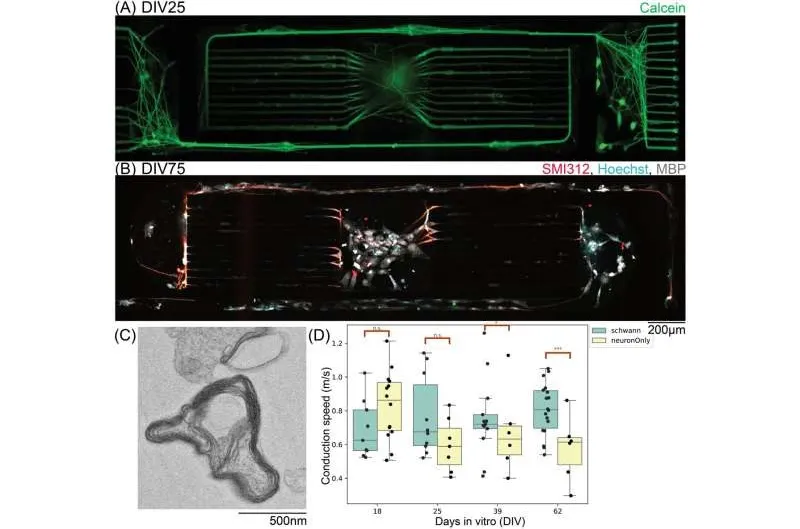
Researchers at Rice University and ETH Zurich published a nerve-on-chip platform on 26 August 2026 in Advanced Healthcare Materials that grows human-derived sensory neurons alongside Schwann cells, the cells that wrap nerve fibres in myelin. The device, called hydroMEA, combines a soft hydrogel with a multi-electrode array, so the tissue sits in a material tuned to the stiffness of real nerve rather than on rigid plastic.
The neurons survived more than 100 days. Where Schwann cells were present and myelin formed, signals travelled faster, and the measured conduction velocities fell in the same range as those of human sensory nerves. Christina Tringides of Rice, the corresponding author, notes that conventional laboratory surfaces are far more rigid than tissue such as brain.
The work is in vitro. No animal or human received anything.
Its value is as a testbed: myelin loss underlies multiple sclerosis and a range of peripheral neuropathies, and until now there was no human-cell system where the thing clinicians care about — how fast a nerve actually conducts — could be read out directly while drugs, toxins or electrical stimulation were applied to it.