A stroke pilot lets the good arm drive the impaired one
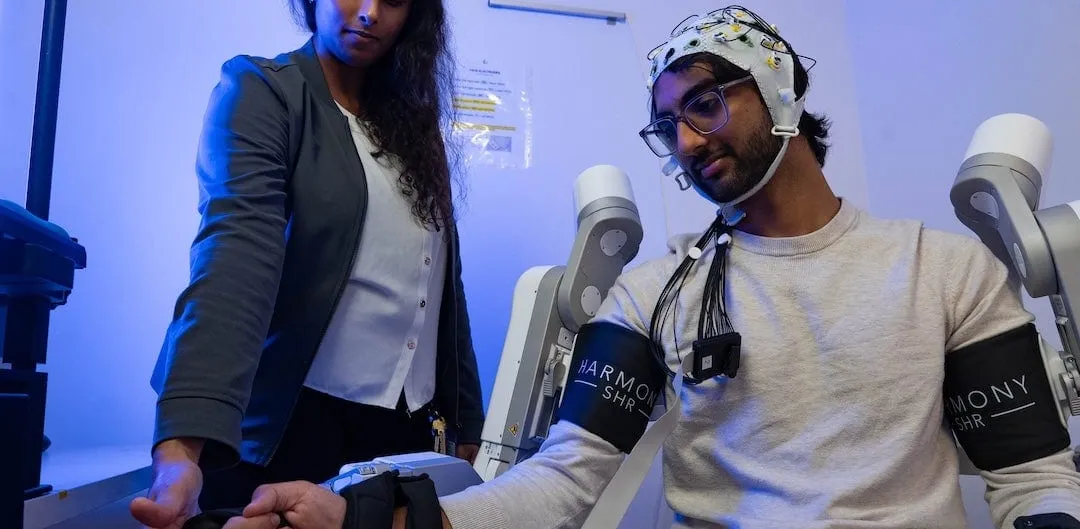
Jared Jones / Rice UniversityPress kit
Rice University said on 12 August 2026 that Keya Ghonasgi of its mechanical engineering department and Simon Fischer-Baum of psychological sciences, with Sheng Li of UTHealth Houston’s Neurorehabilitation Research Laboratory, have begun a pilot study of a full-arm bilateral wearable exoskeleton for stroke rehabilitation. It recruits 10 people at least six months past their stroke, and is funded by a TIRR Foundation Founders Award for Neurotrauma Research.
Robotic rehabilitation usually moves the impaired limb for the patient. This device reverses the direction of authority: the unaffected dominant arm performs a movement and the exoskeleton transfers it to the more impaired arm, so the patient’s own intention drives the assisted side rather than a preset trajectory. The question the pilot asks is whether that patient-driven coupling recruits the damaged motor system more effectively than passive assistance, measured through EEG, EMG and movement quality across conditions.
Ten participants in the chronic phase will not settle it. What the study can establish is whether the effect is worth measuring at scale, and the chronic phase is the harder test: these are people whose spontaneous recovery has already plateaued.