First US patient gets a bone-anchored, mind-controlled bionic arm
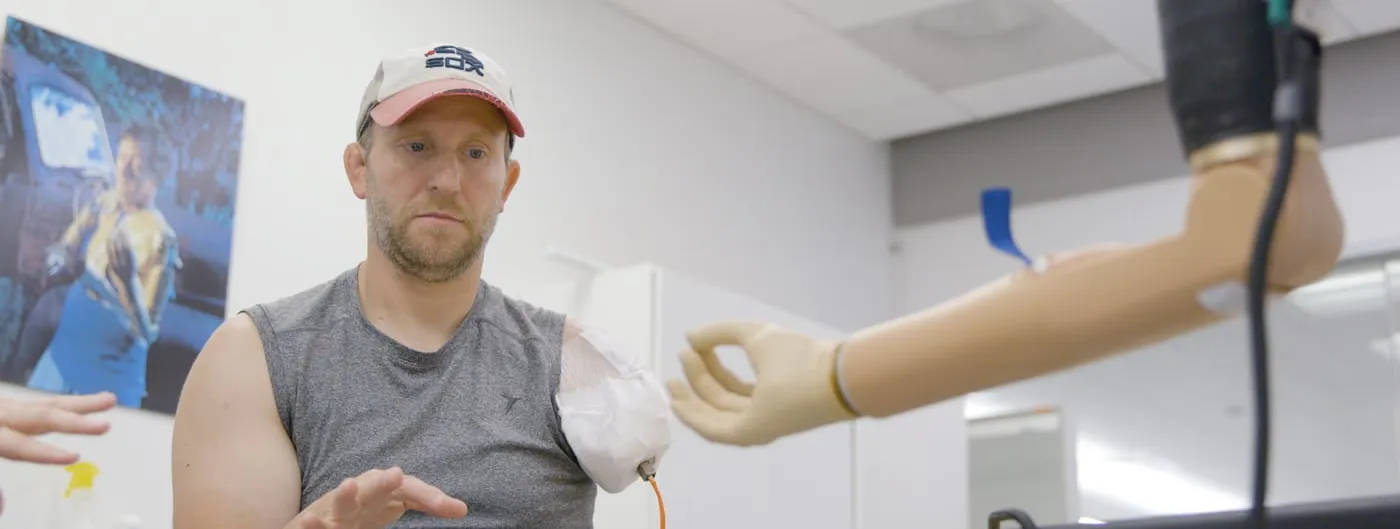
A man who lost his left arm above the elbow in a 2016 construction accident became the first person in the United States to receive the e-OPRA system, in surgery at Northwestern Memorial Hospital on 15 July 2026. Shirley Ryan AbilityLab announced the milestone on 17 September.
Three things are combined in one implant. A titanium fixture is anchored into the residual bone, so the prosthesis attaches to the skeleton rather than hanging from a socket. Electrodes implanted on muscle read the signals that drive it. Cuff electrodes around nerves push current the other way, back toward the brain, to give the wearer a sense of touch from a hand that is not there.
Socket-mounted arms are abandoned often, and the reasons are mundane: they slip, they sweat, they hurt, and surface electrodes lose the signal when skin moves. Anchoring to bone and reading from inside the muscle addresses both ends of that failure.
The study is led by Levi Hargrove of the Regenstein Foundation Center for Bionic Medicine, with surgeons Jason Ko and Terrance Peabody. Eight participants are planned over five years, funded by an $8.7 million award from the NIH’s neurological disorders institute and concluding in 2030. This is participant one.