Base editing cuts toxic huntingtin in mice and holds for a year
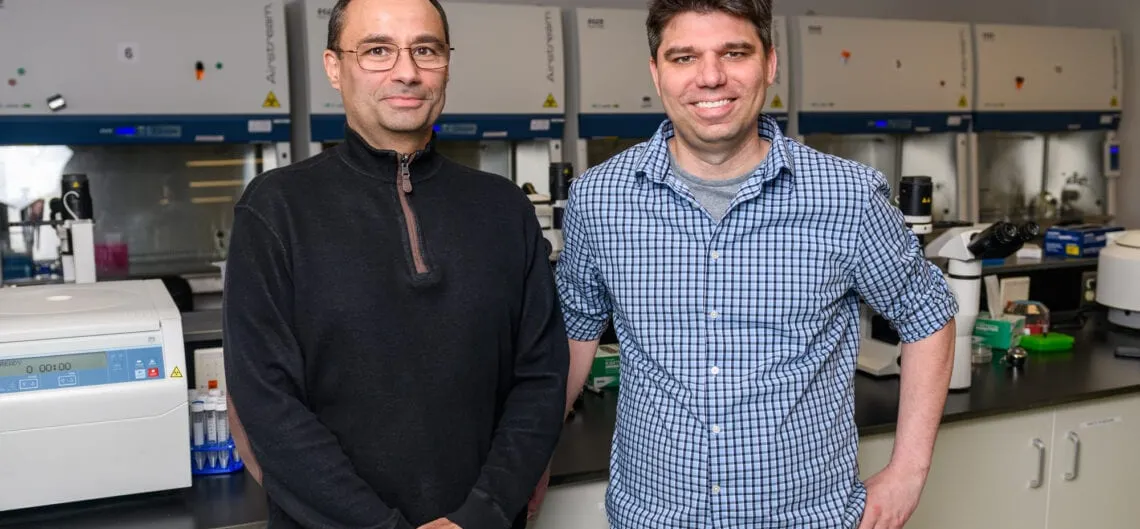
Craig Pessman / University of Illinois Urbana-ChampaignPress kit
Bioengineers at the University of Illinois Urbana-Champaign, led by Pablo Perez-Pinera and Thomas Gaj, used an adenine base editor to change how the huntingtin gene is spliced rather than to cut it out. Two AAV9 vectors carrying a near-PAMless SpRY editor were injected into both sides of the striatum in one-month-old YAC128 mice, a model of Huntington’s disease. The work was published in Nature Biomedical Engineering on 29 July 2026 (DOI 10.1038/s41551-026-01747-y).
Editing the splice signal makes the cell skip exon 13, removing the segment that produces the aggregating N-terminal fragment. At twelve months the striatum showed about 16% editing in bulk tissue and 9% exon skipping — modest fractions that nonetheless cut toxic huntingtin fragments by 60% and left 63% fewer cells carrying inclusions. Treated mice had better grip strength and rotarod performance, less limb clasping, and less loss of striatal and cortical volume than controls.
The strategy matters because Huntington’s is dominant and the healthy copy is needed: approaches that lower huntingtin indiscriminately risk taking the good one down too. This one leaves the protein in place and removes the piece that misbehaves.
This is a mouse study. No human has received it.