United Imaging and Tianjin University put a BCI inside an MRI scanner
AI-generated illustrationAI-generated illustration
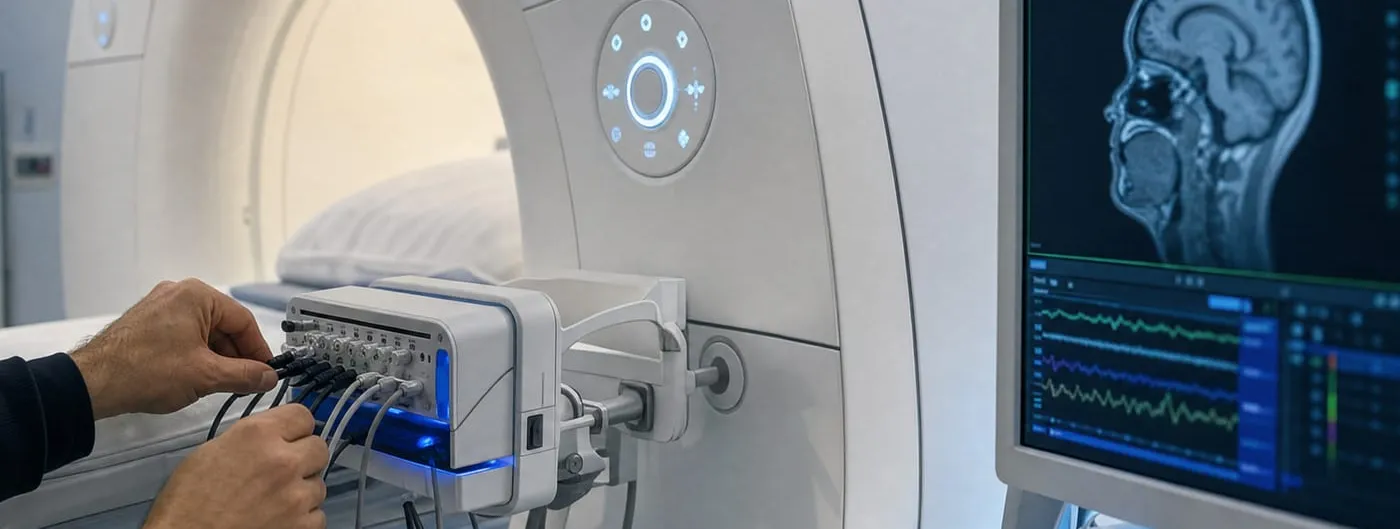
Shanghai United Imaging Healthcare and the Haihe Laboratory of Brain-Computer Interaction and Human-Machine Integration at Tianjin University announced uMR Shenguan on 24 August 2026, a system that folds signal acquisition, decoding, brain stimulation and effect evaluation into a single magnetic resonance platform. The claim attached to it is that it is the first full-stack MRI-based brain-computer interface.
The engineering problem it addresses is mutual interference. An implanted or worn BCI distorts the magnetic field around it and degrades the image; the scanner’s gradients and radiofrequency pulses in turn corrupt the interface. United Imaging says the system compensates for those distortions and ships a magnetically compatible BCI toolbox, which is what allows the scanner to sit inside the loop rather than beside it. The stated performance is millisecond-scale signal capture with sub-millimetre structural measurement.
Named applications are motor rehabilitation, neuro-critical care, psychiatry, ophthalmology and audiology.
An announcement is not a clearance, and the two organisations have published no trial data with it. What an MRI in the loop would buy, if the claims hold, is the ability to see where a stimulation landed rather than infer it from behaviour.