A snap-together electronic skin for prosthetic touch
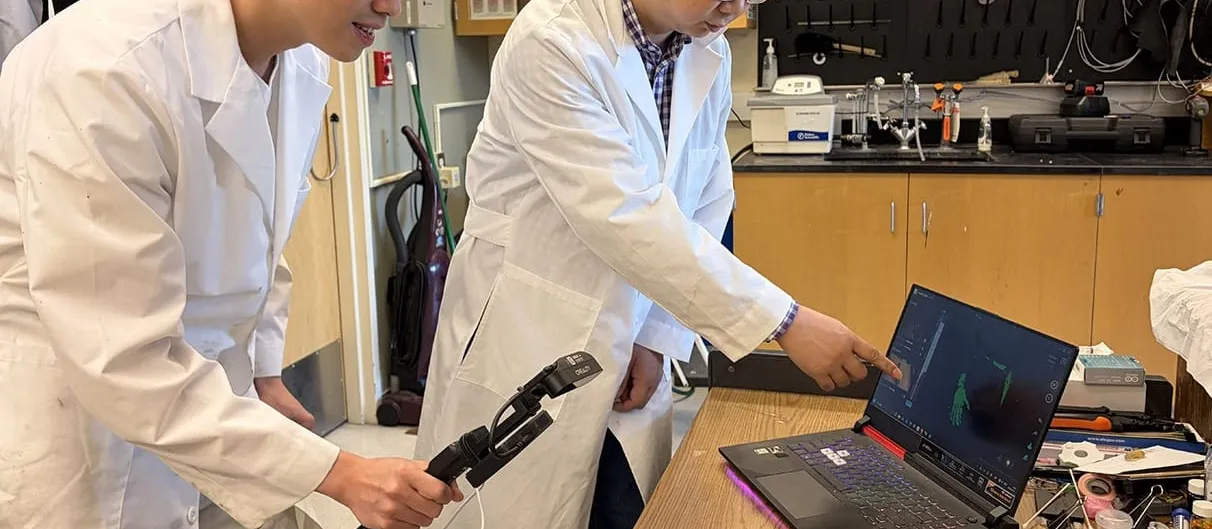
Sravanthi Yalamanchili/WSUPress kit
Researchers at Washington State University have built an electronic skin that detects pressure and temperature at ten times finer resolution than commercial glove sensors, reported in Cell Reports Physical Science and announced by the university on 20 August 2026.
The design is modular. Sensor modules snap together rather than being bonded with adhesive, and the assembly is fitted to the freeform shape of an individual limb through a scan-model-print workflow using 3D printing and laser cutting. The team frames low cost and manufacturing simplicity as the point: methods simple enough to put medical-grade e-skin within reach of ordinary clinical production rather than specialist fabrication.
Hongyi Shen, a graduate student in the School of Mechanical and Materials Engineering, and Professor Kaiyan Qiu led the work, with Prashanta Dutta as a corresponding author. The project was supported in part by WSU’s National Science Foundation Research Traineeship in Next-Generation Robotics.
The sensing half is the half that exists. The group has filed a provisional patent and is now developing an actuator to convert sensor signals into nerve stimulation, which is what would turn measured pressure and temperature into sensation an amputee could feel. No nerve-stimulation or human-feedback trial has been run; the work remains at laboratory prototype stage.