A prosthetic socket sensor mimics touch and pain perception
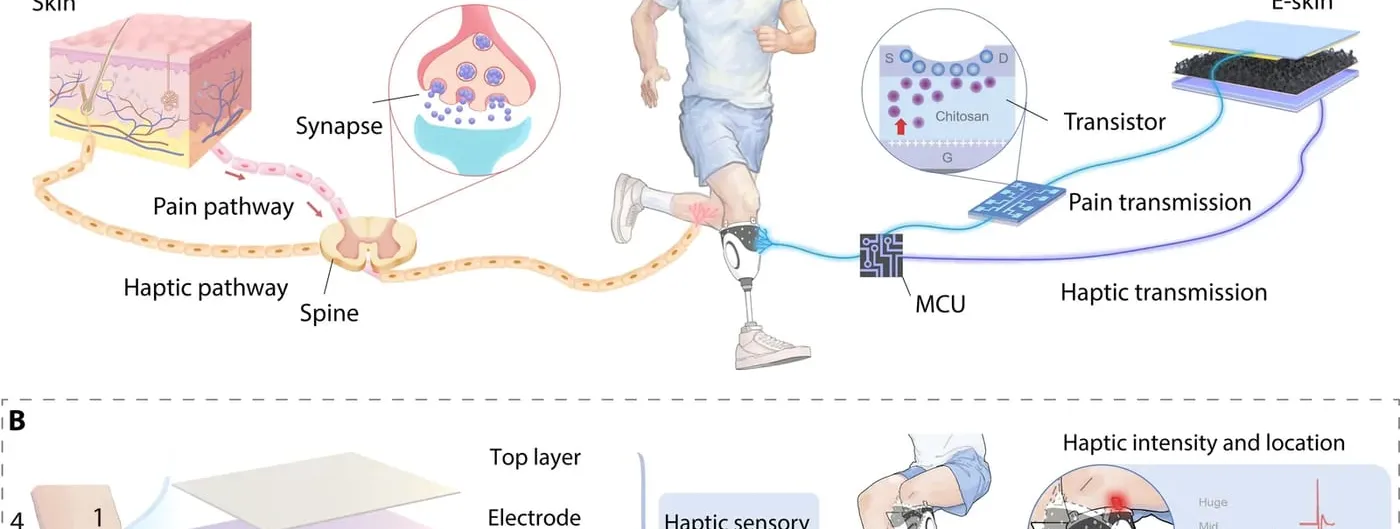
Researchers at Zhejiang University of Technology and the Beijing Institute of Technology described on 1 October 2026, in the journal Cyborg and Bionic Systems, a sensor array for the socket of a lower-limb prosthesis that separates ordinary touch from loads likely to hurt.
The 2x2 array pairs two sensing modules. A piezoelectric module registers contact quickly, with response and recovery times of 5 and 4 milliseconds. A piezoresistive module, with a sensitivity of 57.9 kPa⁻¹ and response and recovery of 31 and 43 milliseconds, tracks pressure and stayed stable over 2,000 loading cycles. Its output drives a synaptic transistor that mimics pain sensitisation: repeated or heavy loads raise its response, and once a threshold is crossed the system signals an avoidance response.
The team tested the array in people with transtibial amputation while they sat, walked, climbed stairs, jumped and ran, mapping pressure across the socket and flagging abnormal loading. These were feasibility trials; the number of participants is not given in the coverage, and the researchers say larger groups and other amputation types come next.